Hydrogen presentation cover slide with the title 'Hydrogen Presentation' and the subtitle 'An Evolution in Agriculture, Health, Water Conservation, and Our Environment.' It features a background image of a tractor working in a field and graphic elements of water bubbles on the right side.
A laboratory flask with water and bubbles, positioned on the soil among green plant sprigs, representing green technology and sustainability.
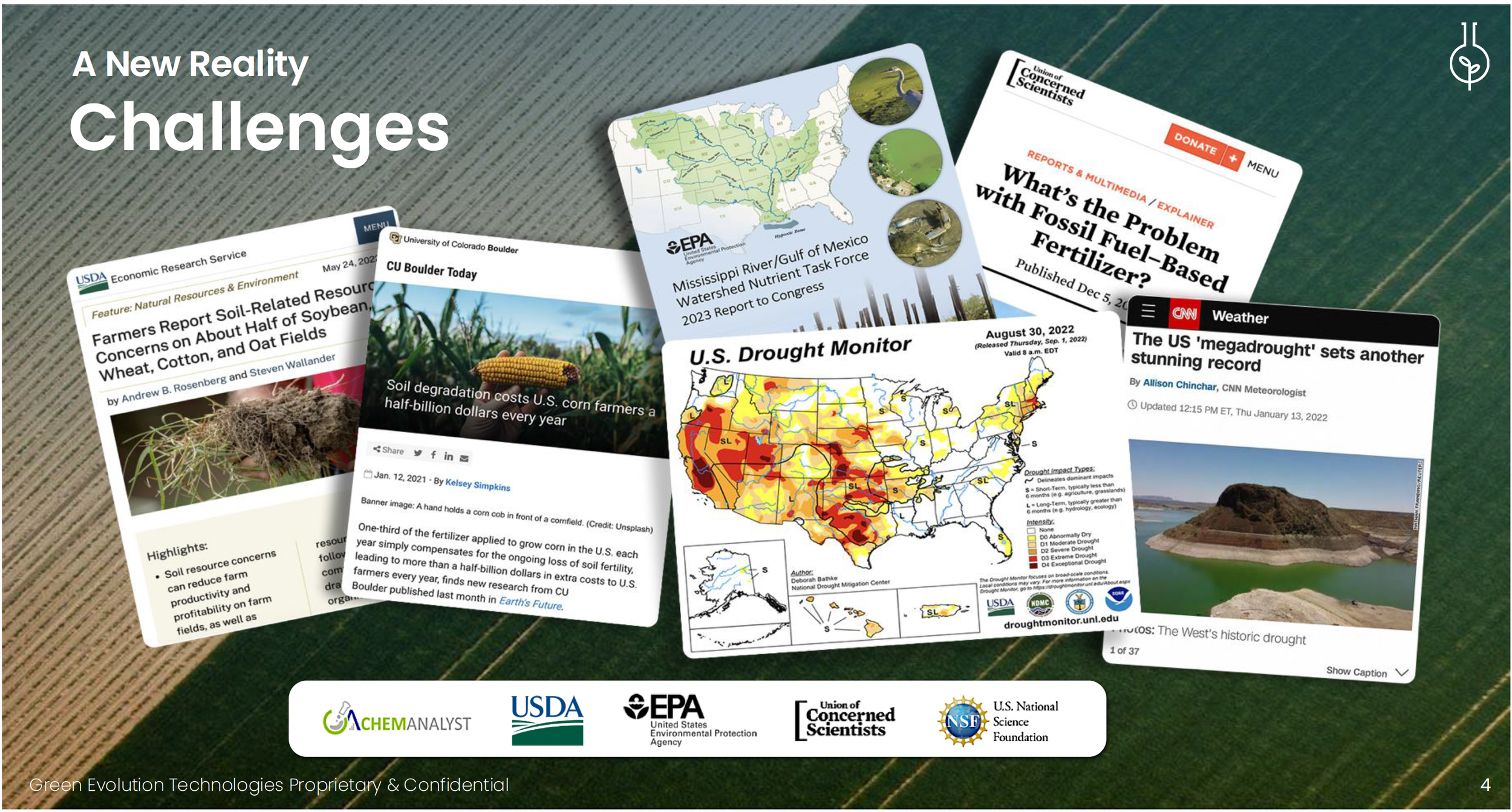
Digital collage of environmental news articles and reports, including topics like soil resources, soil degradation, water management, drought monitoring, and fossil fuel-related issues, with logos of environmental agencies at the bottom.
Infographic highlighting the biggest issues facing global agriculture and food security, including water drought and conservation, rising input costs, nitrogen overuse and leaching, and soil erosion and degradation, with corresponding images of irrigation, crop spraying, scientific research, and soil disturbance.
Comparison of fertilizer usage methods showing regular nitrogen leads to nitrogen overuse and toxic leaching, illustrated with a farm, clouds, and warning icons; hydrogel plus nitrogen method shows increased absorption, efficiency, and reduced leaching, depicted with similar farm and icons.
Infographic explaining hydrogels, including their properties and applications, with a background image of a farming field and a tractor. Includes text sections: super absorbent, maintains structure, efficient production, reduce fertilizer, and market outlook. Shows images of agriculture, contact lenses, hygiene products, drug delivery, and wound dressing.
An infographic titled 'Traditional Hydrogel Limitations' discusses challenges in hydrogel adoption, including high costs of non-toxic materials, toxic byproducts from current manufacturing, intensive production processes, low water absorption rates, contaminated hydrogels requiring extensive water and treatment, and the need for high temperatures and time in production.
Infographic with a background image of scientists working with plants in a laboratory, highlighting the process of continuous frontal polymerization for hydrogel production, including features like non-toxic, biodegradable, low-cost, customizable properties, high absorption rate, eco-friendly, and controlled structure.
A promotional infographic describing the benefits of a low-cost, non-toxic hydrogel for agriculture. It highlights improvements in water reduction, fertilizer reduction, soil erosion and health, and crop yield, supported by percentages and bullet points. The background features a woman working in a green field.
Infographic titled 'Green Evolution Technologies Hydrogel Benefits' listing benefits such as non-toxic and biodegradable, low-cost, customizable properties, increased crop yields, water conservation, carbon sequestration, and cured defects and damages, with icons representing each benefit. The background features a sprouting plant and water droplets.
An infographic titled 'Key Milestones' with various sections about funding, hydrogel test growth, precision planting, university partners, a hydrogel test named 'Nano Silver,' and inbound demand. Each section contains bulleted points detailing achievements and collaborations related to agricultural technology and research.
Infographic showing results of Hydrogel testing, highlighting percentage increases in crop yields for corn, soybeans, winter wheat, and net profit per acre, with logos of multiple universities and organizations at the bottom.
Slide titled 'Key Trials and Partnerships' with logos of universities and organizations, including South Dakota State University, University of Arizona, Cornell University, UC Davis, and others. Text describing partnership testing, R&D, and educational programs, and from trials to purchase orders with details about funding and research results. Background features green plants and a person in a checkered shirt.
An image from Fresno State celebrating their May 2025 win at the START, GROW, & STAY conference. The image shows a man and woman sitting at a table exhibiting their project, with one holding a award. The table has materials related to hydrogen and tree growing.
Table of crop data showing yield, price, revenue, fertilizer, water, costs, hydrogel impact, net profit per acre, and percentage of revenue for various crops like corn, beans, lettuce, tomatoes, and peppers, with background of green farm field.
A comparison chart of different hydrogel technologies featuring traditional hydrogels, biohydrogels, and G.E.T. hydrogels. The chart highlights advantages such as high absorption rates, low cost, low water consumption, biodegradability, and simple production process for G.E.T. hydrogels.
A graphic presentation titled 'Green Evolution Technologies' with the subtitle 'What sets us apart'. It features three sections: 'Scientific Innovation' with an image of a scientist in a lab with blue lighting; 'Engineering Excellence' with a photo of two workers operating machinery in a cleanroom; 'Mathematical Precision' with an image of a woman writing mathematical equations on a transparent board, with two scientists in lab coats in the background.
Flowchart showing related party patent/IP associations among Arzame s.r.o., Green Evolution Technologies, and DavTechLab LLC, including ownership and rights details for each entity.
A table of key patents and intellectual property rights showing owners, titles, serial numbers, notes, and status, with a green background and the title 'Key Patents & Intellectual Property' at the top.
A promotional infographic for G.E.T. Hydrogel + Nano Silver technology, highlighting its benefits for crop and soil health, anti-pathogen properties, increased yields, and reduced growth cycle timelines. The infographic compares G.E.T. Nano Silver with other products based on method, composition, size, bioavailability, side effects, long-term use, and concentration stability, emphasizing its direct washing, deionized water with silver nanoparticles, spherical particles, high bioavailability, non-toxicity, and unlimited use. Additional features include cost-effectiveness, proprietary formula, domestic manufacturing, and proven soil care efficacy.
Infographic displaying test results for a hydrogen and nano silver treatment, highlighting increased spore growth speed, plant yields, and corn yields, reduced water consumption, and cured defects and damages.
Aerial view of agricultural fields at sunrise with overlayed infographic comparing US market sizes for G.E.T. crops, showing US agriculture market at $370 billion, total available market at 200 million acres, California serviceable market at 24 million acres, and obtainable market at $3.6 billion for 2 million acres.
Map of the United States displaying plans to build 20 full-run facilities for growth machines, with regions marked and labeled for California, Midwest, Southeast, and Texas, each with numbers of facilities indicated.
A computer screen display shows two charts about the hydrogel market. The left chart is a line graph titled 'U.S. Hydrogel Market Size Projection (2024-2030)' with increasing dollar values from $5.4 billion in 2024 to $8.3 billion in 2030. The right chart is a bar graph titled 'Global Hydrogel Market Size 2022-2034 (USD Billion)' with values rising from $28 billion in 2024 to $57 billion in 2034.
Information slide about USDA Code 450, The Food Security Act of 1985, discussing reimbursement for hydrogel application to prevent soil erosion, including details on incentives, eligibility, and costs, with a background of farmland and a spray tank machine.
Graph comparing different products' absorption rates and costs per acre in agriculture, with a background of a farm field. The x-axis shows cost per acre from low to high, and the y-axis shows absorption rate from low to high. Sanyo and BountiGel are positioned in high-cost, high-absorption area; CalPam, SOCO, and Shandong are in low-cost, low-absorption area; G.E.T is in low-cost, high-absorption area, marked with green icons.
A presentation slide titled 'Go-to-Market / Distribution' with two columns of text. The left column titled 'Focus' discusses third-party research, market awareness, and outreach efforts including specific events. The right column titled 'Early Traction' talks about successful trials, partnerships with agriculture distributors and seed companies, and sales projections. The background shows a tractor spraying water on farmland, and the slide footer indicates it is proprietary content from Green Evolution Technologies, with slide number 28.
Profile pages of three scientists on a green-themed background, titled 'Foundational Science Team'. The first is Dr. Anhit Tonoyan, a scientific author in pink shirt. The second is Dr. Sevan Davtyan, a chemical sciences PhD in a suit. The third is David Davtyan, a senior researcher in a suit and glasses.
A timeline infographic titled 'Company Origins & Background' detailing the history of a technology company from the 1970s to 2022. The timeline includes milestones such as research in 1970s, engineering developments in 2005, advances in 2006, development in 2010, prototype success in 2018, and launch in 2022. A background image shows three scientists or engineers working in a high-tech greenhouse or laboratory environment.
A group of five adviser profile cards displayed against a background of green fields and a blue sky with solar panels. Each card features a professional headshot, name, role as adviser, and a logo of their affiliated organization.
A financial report on a green background with the title 'Financial Highlights' and a subtitle 'Successful Pilots Validated the Production Quality, Cost, and Speed'. The report contains a table with columns for dates from 6/30/23 to 5/31/24, detailing pilot facility capital spend, upfront capital costs, production volume, revenue, raw material costs, variable costs, COGS, personnel expense, marketing and crop testing, legal, travel and logistics, rent, fixed G&A, operating expense, other capital expense, net cash flow, and total investment need. To the right, there's a section titled 'Successful Pilots' explaining the validation of production processes by G.E.T. and the successful manufacturing of hydrogel for third-party testing in spring 2024. The footer notes 'Green Evolution Technologies Proprietary & Confidential' with page number 33.
A projected timeline for plant development, displayed over a background of farmland and a blue sky. It includes phases from 2023 to 2026, with milestones in seed funding, test growing, facility construction, and commercialization.
A thank you slide for Green Evolution Technologies showing a green plant sprout with leaves, a hand sprinkling granular substance, and blue molecular structures, with contact information for Jon Licata.

Green Evolution Technology is a current project that I am deeply passionate about. GET is changing the way food will be produced by greatly increasing crop yields, combating drought, and recuding harmful chemical pollutants.